DCW
R. & C. Eames
DCW Chair designed by Ray & Charles Eames, circa 1950-52
Zenith Edition – Evans – 1950
Molded plywood
Stamped Herman Miller / Evans
2 chairs available
During WWII, Ray and Charles Eames conducted numerous experiments in search of new techniques to better adapt molded plywood to the human body (see their now-famous leg splint for war injuries).
These experiments gave birth to the Plywood Group seats, characterized by molded plywood shells, backs and legs. The DCW (Dining Chair Wood), with its organic curves and inviting warmth of wood, encourages a relaxed posture. It was produced in natural or black ash, and also came in a lounge version (LCW) with a lower seat.
Share our design collection

Price : €2750.00 including tax per unit – 2 chairs available
Leg Splint
R. & C. Eames
This molded plywood leg splint was designed by Charles & Ray Eames.
1940s/50s
This is one of the first production pieces by the famous husband-and-wife design team.
In fact, this molded plywood leg splint was designed by Charles & Ray Eames. It stands as one of the earliest production works by the iconic duo.
During World War II, the U.S. Navy enlisted Charles and Ray Eames to develop a lightweight, affordable leg splint. The resulting modular object, both sculptural and functional, was designed for mass production and easy transport. Gaining access to military technology and manufacturing facilities allowed the Eameses to refine the molded plywood technique they had been exploring for years. The biomorphic shape of the splint foreshadows the couple’s later influential designs in molded plywood furniture.
Share our design collection

LCW
R. & C. Eames
The LCW chair was designed by Ray & Charles Eames, circa 1948.
Edition Zenith – Evans – unique piece
Molded plywood
Stamped Herman Miller / Evans
Moreover, the LCW (Lounge Chair Wood) armchair is an iconic creation by Ray & Charles Eames, dating from the period of their early experiments with three-dimensional molded plywood: the late 1940s. These armchairs were first produced by Zenith, then by Herman Miller in the United States. They became legendary, icons of design furniture, and are now produced by Vitra in Europe. This original version, dating from the early 1950s, is particularly sought after, as the original red hue has faded over time.
Share our design collection

Accropoli
Ettore Sottsass
Wood and lacquer
73 1/5 × 89 4/5 × 23 3/5 in
186 × 228 × 60 cm
Edition of 20
1998
Additionally, Ettore Sottsass is a major designer of the 20th century. He is renowned for his spiritual and sensory approach to design and architecture. He is the founder of the Memphis group. He designed numerous pieces, placing particular importance on color and light. He is the creator of design icons such as the Asteroid lamp (1968), the Carlton bookcase (1981), the Westside armchair (1983), and the Ospité table (1984).
“To design is not to give shape to a more or less stupid product for a more or less luxurious industry. For me, design is a way to discuss life.”
Share our design collection

Chamrousse
Ch. Perriand
Chamrousse chair model by Charlotte Perriand
manufactured by the Sentou workshop in Lalinde in 1966/1967
Origin: Private collection
Dimensions: 58 × 62 × H 78 cm – Ash wood and marsh rush straw
The Chamrousse chair, also known as the “paillé” (straw-seated) chair – circa 1965 – was manufactured in the 1960s by the Sentou workshop in Lalinde, in the southwest of France. This workshop was founded by Robert Sentou, where he also produced his own furniture. This Charlotte Perriand chair was originally part of a production run for a hotel in the Flaine ski resort. Legs and structure made of solid ash, with a seat and backrest woven from marsh rush straw, it is an iconic piece of 20th-century design furniture.
Share our design collection

Cansado
Ch. Perriand
However, the “Cansado” bench was created by Charlotte Perriand in 1956 Edition Steph Simon 1956–1974
Origin: Cansado Mining City – Mauritania
Dimensions: 260 × 70 × H 35 cm – Ash wood and black laminate on a drawer unit
Black lacquered steel frame
Charlotte Perriand’s Cansado model bench was produced by Steph Simon in the 1950s.
Steph Simon, an Arts et Métiers engineer, was a true pioneer of modernist furniture. He collaborated with some of the greatest designers of the time, including Jean Prouvé, Isamu Noguchi, and Serge Mouille. In 1956, he opened his gallery at 145 Boulevard Saint-Germain, along with a design office dedicated to interior projects.
Charlotte Perriand, already well-known for her creations with Le Corbusier and Jean Prouvé, later worked independently and became the artistic director of Simon’s gallery.
Share our design collection

Totem Menta
Ettore Sottsass
Glazed earthenware, particleboard covered with plastic laminate.
1986
Glazed earthenware, particleboard panels covered with plastic laminate.
85 × 19 7/10 × 19 7/10 in
216 × 50 × 50 cm
Edition of 20
In fact, Ettore Sottsass is a major designer of the 20th century. He is renowned for his spiritual and sensory approach to design and architecture. He is the founder of the Memphis group. He designed numerous pieces, placing particular importance on color and light. He is the creator of design icons such as the Asteroid lamp (1968), the Carlton bookcase (1981), the Westside armchair (1983), and the Ospité table (1984).
“To design is not to give shape to a more or less stupid product for a more or less luxurious industry. For me, design is a way to discuss life.”
Share our design collection

Table Tray
Fritz Hansen
Willumsen & Engholm design, 1958
Fritz Hansen Edition
Teak plywood tabletop – diameter 60 cm
Black lacquered folding legs
Stamped Fritz Hansen
The Tray Table – a foldable table with a removable tray – was designed by Willumsen & Engholm in 1958. It is currently produced by Fritz Hansen in a slightly updated version of the original. The tray, featuring curved edges, is made using thermo-molded plywood technique, while the folding base is crafted from solid oak. Fritz Hansen is a Danish furniture manufacturer. Designers who have collaborated with Fritz Hansen are renowned worldwide and include Arne Jacobsen, Poul Kjærholm, Hans J. Wegner, and Piet Hein.
Share our design collection

Office cane chair
Pierre Jeanneret
Set of 4 Office Chairs – "Office Cane Chairs" (1955-1956)
Pierre Jeanneret – Chandigarh
Solid teak frame with woven cane seat and backrest.
Double compass-style side legs, connected by two crossbars, forming the armrest supports. Inclined, slightly curved backrest, attached to the seat by two small lower supports.
Dimensions: H 76.4 cm x W 50 cm x D 47 cm
Provenance: University residences of Panjab University, Sector 14 and Chandigarh administrative buildings, Sector 1.
These chairs, made of solid teak, feature a woven cane seat and backrest.
Dual lateral compass legs, connected by two stretchers, providing structural support for the armrests. The backrest is inclined and slightly curved, attached to the seat with two small supports at the bottom. This model was designed and produced for various administrative buildings in the city of Chandigarh, India, around 1955 by Pierre Jeanneret. He was Le Corbusier’s cousin and closest collaborator, with whom he co-designed the entire city of Chandigarh in Punjab during the 1950s. Today, original Chandigarh furniture by Pierre Jeanneret is highly sought after and considered collectible pieces. A certificate of authenticity will be provided to buyers.
Share our design collection

€7,500 incl. VAT per unit – 4 chairs in stock
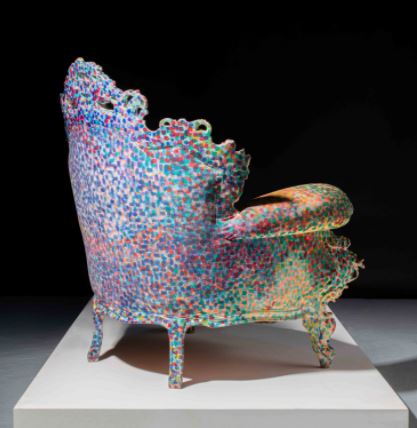
Proust
A. Mendini
Wood and hand-painted fabric
40 9/10 × 41 3/10 × 34 3/5 in
104 × 105 × 88 cm
Proust, ca. 1978 – 2008
Alessandro Mendini is an Italian artist and architect known for his eclectic and postmodern style. At the forefront of contemporary design, his multidisciplinary practice integrates buildings, art furniture, decorative objects, as well as paintings and installations.
“I connect shapes with the pattern of painters in a very methodic way”
Share our design collection

Cansado
Ch. Perriand
Cansado sideboard model – Charlotte Perriand, created in 1956
Steph Simon Edition 1956-1974
Provenance: Cansado mining city – Mauritania
Dimensions: 158 × 45 × H 71 cm – Mahogany veneer and white and black doors
Black lacquered steel structure
Charlotte Perriand’s Cansado sideboard was edited by Steph Simon in the 1950s. Steph Simon, an engineer from the Arts and Crafts, was a true pioneer of modernist furniture, in contact with the greatest designers of the time (Jean Prouvé, Isamu Noguchi, Serge Mouille…). In 1956, he opened his gallery at 145 Boulevard Saint-Germain, as well as a design office to create interior fittings. Charlotte Perriand, widely known for her creations with Le Corbusier, Jean Prouvé, and later on her own, became the artistic director of his gallery.
The sideboard dates from 1958 and comes from the Cansado mining city in Mauritania. It consists of 4 drawers and 2 sliding doors, with a mahogany veneer structure and black lacquered metal legs.
Share our design collection

CH27
Hans Wegner
Pair of original CH27 armchairs – Hans Wegner
Edition: Carl Hansen & Son, Circa 1949 – 1959
Dimensions: H 77 cm × W 72 cm × D 77 cm
Oak and wicker.
With their production halted in the 1950s, these two armchairs are now considered rare, iconic pieces of design history.
Hans Wegner, a Danish architect, is considered a founder of Scandinavian design. He is the author of nearly 500 wooden chairs, including the famous “the chair,” selected by John F. Kennedy for use in the White House.
Today, his creations are mainly edited by Carl Hansen and PP Möebler, with whom Bel Œil collaborates regularly.
This set of CH27 armchairs is particularly rare, as their production stopped before 1959.
These armchairs feature a woven cane seat and back, supported by a sturdy oak structure with armrests and legs. The upper hooks were used to attach and hang a back cushion.
Share our design collection

€8,000.00 incl. VAT per unit – 2 armchairs in stock.
Mania Cabinet
A. Mendini
65 × 49 1/5 × 17 7/10 in
165 × 125 × 45 cm
AP1/3 + 1AP Edition
ca. 2008
Wood, fiberglass, and gold-plated brass.
This cabinet is part of a limited series of four and bears the 1AP marking.
Alessandro Mendini is an Italian artist and architect known for his eclectic and postmodern style. At the forefront of contemporary design, his multidisciplinary practice integrates buildings, art furniture, decorative objects, as well as paintings and installations.
“I connect shapes with the pattern of painters in a very methodic way”
Share our design collection

Easy Armchair
Pierre Jeanneret
Easy Armchair Pierre Jeanneret
Pair of "Cane and Teak Wood Armchairs" (1955-1956)
Chandigarh – Pierre Jeanneret
Solid teak with woven cane seat and backrest. Double side leg structure in “compass” style, joined by two stretchers and forming the armrest support.
Inclined, slightly curved backrest, attached to the seat by two lower uprights.
Dimensions: H 72 cm x W 50 cm x D 71 cm
Provenance: University residences of Panjab University, Sector 14, and administrative buildings of Chandigarh, Sector 1.
Moreover, this pair of Easy Armchairs by Pierre Jeanneret, also known as “Cane and Teak Wood Armchairs”, comes from the university residences of Panjab University, Sector 14, and the administrative buildings of Chandigarh, Sector 1. They were designed by Pierre Jeanneret in 1955/56. Jeanneret was the cousin and closest collaborator of Le Corbusier, with whom he designed the entire city of Chandigarh, in Punjab, in the 1950s. These armchairs are made of solid teak with a woven cane seat and backrest. The double side leg structure in “compass” style is joined by two stretchers forming the armrest support. The backrest is inclined and slightly curved and attached to the seat by two lower uprights. The original Chandigarh furniture by Pierre Jeanneret is highly sought after today and considered collectible items. A certificate will be provided to the buyers.
Share our design collection

€8,500.00 incl. VAT per unit – 2 armchairs in stock
Spider Lamp
Joe Colombo
Lamp designed by Joe Colombo in the 1960s for Oluce.
The black reflector is adjustable and slides along the chromed metal rod. This lamp received the Compasso d’Oro in 1967.
Thus, Joe Colombo is one of the greatest Italian designers of the 20th century. He is famous for his futuristic and imaginative design of everyday furniture and his taste for modularity and functionality in pieces.
Share our design collection